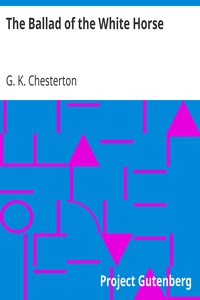
The Ballad of the White Horse by G. K. Chesterton

(6 User reviews)   4773
By Ava Marino Posted on Dec 26, 2025
In Category - Old Maps
Chesterton, G. K. (Gilbert Keith), 1874-1936 Chesterton, G. K. (Gilbert Keith), 1874-1936
English
Picture this: King Alfred, the last Saxon king, hiding in a swamp. His kingdom is gone, his army scattered, and the Vikings own England. Then, in a moment of quiet despair, he has a vision of the Virgin Mary. She doesn't offer an easy win. Instead, she tells him a strange truth: that the hopeless fight is the only one worth fighting. This is the stunning, epic poem that asks: what do you do when everything is lost? It’s not just about swords and shields; it’s about the fire you keep burning when the whole world has gone dark. If you've ever felt outnumbered, outgunned, or just plain tired, this ancient story will feel shockingly new.
Share

Read "The Ballad of the White Horse by G. K. Chesterton" Online

This book is available in the public domain. Start reading the digital edition below.

START READING FULL BOOK
Instant Access    Mobile Friendly

Book Preview

A short preview of the book’s content is shown below to give you an idea of its style and themes.

still alive in the land. I will give three curt cases of what I mean. A tradition connects the ultimate victory of Alfred with the valley in Berkshire called the Vale of the White Horse. I have seen doubts of the tradition, which may be valid doubts. I do not know when or where the story started; it is enough that it started somewhere and ended with me; for I only seek to write upon a hearsay, as the old balladists did. For the second case, there is a popular tale that Alfred played the harp and sang in the Danish camp; I select it because it is a popular tale, at whatever time it arose. For the third case, there is a popular tale that Alfred came in contact with a woman and cakes; I select it because it is a popular tale, because it is a vulgar one. It has been disputed by grave historians, who were, I think, a little too grave to be good judges of it. The two chief charges against the story are that it was first recorded long after Alfred's death, and that (as Mr. Oman urges) Alfred never really wandered all alone without any thanes or soldiers. Both these objections might possibly be met. It has taken us nearly as long to learn the whole truth about Byron, and perhaps longer to learn the whole truth about Pepys, than elapsed between Alfred and the first writing of such tales. And as for the other objection, do the historians really think that Alfred after Wilton, or Napoleon after Leipsic, never walked about in a wood by himself for the matter of an hour or two? Ten minutes might be made sufficient for the essence of the story. But I am not concerned to prove the truth of these popular traditions. It is enough for me to maintain two things: that they are popular traditions; and that without these popular traditions we should have bothered about Alfred about as much as we bother about Eadwig. One other consideration needs a note. Alfred has come down to us in the best way (that is, by national legends) solely for the same reason as Arthur and Roland and the other giants of that darkness, because he fought for the Christian civilization against the heathen nihilism. But since this work was really done by generation after generation, by the Romans before they withdrew, and by the Britons while they remained, I have summarised this first crusade in a triple symbol, and given to a fictitious Roman, Celt, and Saxon, a part in the glory of Ethandune. I fancy that in fact Alfred's Wessex was of very mixed bloods; but in any case, it is the chief value of legend to mix up the centuries while preserving the sentiment; to see all ages in a sort of splendid foreshortening. That is the use of tradition: it telescopes history. G.K.C. DEDICATION Of great limbs gone to chaos, A great face turned to night-- Why bend above a shapeless shroud Seeking in such archaic cloud Sight of strong lords and light? Where seven sunken Englands Lie buried one by one, Why should one idle spade, I wonder, Shake up the dust of thanes like thunder To smoke and choke the sun? In cloud of clay so cast to heaven What shape shall man discern? These lords may light the mystery Of mastery or victory, And these ride high in history, But these shall not return. Gored on the Norman gonfalon The Golden Dragon died: We shall not wake with ballad...

This is a limited preview. Download the book to read the full content.

The Story

This is a long, beautiful poem about King Alfred the Great. It starts with him at his lowest point, defeated by Viking invaders and hiding in the marshes of Athelney. He feels completely abandoned. In a vision, the Virgin Mary appears to him by the ancient White Horse hill figure. She gives him a confusing message: he will lose, and lose, and lose again... but he must fight anyway.

The poem then follows Alfred as he gathers a ragtag band of men—farmers, outlaws, and old warriors. They face impossible odds in a final, desperate battle against the pagan Danes. It’s a story of faith clinging on by its fingernails, and courage that looks a lot like stubbornness.

Why You Should Read It

Forget dry history. Chesterton makes this feel immediate and urgent. Alfred isn’t some perfect hero on a poster; he’s a doubtful, weary man who chooses to act. The language is muscular and rhythmic, full of unforgettable lines that stick in your head. It wrestles with huge ideas—why fight for a civilization that seems doomed? What’s the point of a victory you won’t live to see?—but grounds them in mud, blood, and the faces of scared men around a campfire.

Final Verdict

Perfect for anyone who loves mythic, language-driven storytelling. If you enjoy the beats of an epic like Beowulf but want a story deeply concerned with Christian hope, this is your book. It’s also for the discouraged idealist, the person who needs a reminder that some causes are worth the long defeat. Fair warning: it’s a poem, so settle in for its unique rhythm. But give it a chapter, and you might just find yourself, like Alfred, ready to get back in the fight.


⚖️ Public Domain Notice

This content is free to share and distribute. Enjoy reading and sharing without restrictions.
Christopher Anderson
1 year ago

After hearing about this author multiple times, the pacing is just right, keeping you engaged. One of the best books I've read this year.

4.5
4.5 out of 5 (6 User reviews )

Add a Review

Your Rating *
There are no comments for this eBook.
You must log in to post a comment.
Log in


Related eBooks