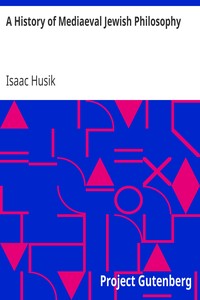
A History of Mediaeval Jewish Philosophy by Isaac Husik

(4 User reviews)   4137
By Ava Marino Posted on Dec 26, 2025
In Category - Old Maps
Husik, Isaac, 1876-1939 Husik, Isaac, 1876-1939
English
Ever wonder what happened to philosophy between Aristotle and the Renaissance? Isaac Husik's book answers that question in a way I never expected. It turns out, while Europe was in what we call the 'Dark Ages,' Jewish thinkers in the Islamic world and beyond were having brilliant, world-shaping debates about faith, reason, and the nature of reality. This book isn't just a dry list of names and dates. It's the story of a thousand-year conversation that helped preserve and transform ancient wisdom. If you think medieval thought was just about knights and castles, this will completely change your perspective. It's a missing piece of history I didn't know I needed.
Share

Read "A History of Mediaeval Jewish Philosophy by Isaac Husik" Online

This book is available in the public domain. Start reading the digital edition below.

START READING FULL BOOK
Instant Access    Mobile Friendly

Book Preview

A short preview of the book’s content is shown below to give you an idea of its style and themes.

student and non-technical reader the results of their researches. What was omitted by the German, French and English speaking writers was accomplished by a scholar who wrote in Hebrew. Dr. S. Bernfeld has written in Hebrew under the title "Daat Elohim" (The Knowledge of God) a readable sketch of Jewish Religious philosophy from Biblical times down to "Ahad Haam." A German scholar (now in America), Dr. David Neumark of Cincinnati, has undertaken on a very large scale a History of Jewish Philosophy in the Middle Ages, of which only a beginning has been made in the two volumes so far issued. The present writer at the suggestion of the Publication Committee of the Jewish Publication Society of America has undertaken to write a history of mediæval Jewish rationalistic philosophy in one volume--a history that will appeal alike to the scholar and the intelligent non-technical reader. Treating only of the rationalistic school, I did not include anything that has to do with mysticism or Kabbala. In my attempt to please the scholar and the layman, I fear I shall have succeeded in satisfying neither. The professional student will miss learned notes and quotations of original passages in the language of their authors. The general reader will often be wearied by the scholastic tone of the problems as well as of the manner of the discussion and argument. And yet I cannot but feel that it will do both classes good--the one to get less, the other more than he wants. The latter will find oases in the desert where he can refresh himself and take a rest, and the former will find in the notes and bibliography references to sources and technical articles where more can be had after his own heart. There is not much room for originality in a historical and expository work of this kind, particularly as I believe in writing history objectively. I have not attempted to read into the mediæval thinkers modern ideas that were foreign to them. I endeavored to interpret their ideas from their own point of view as determined by their history and environment and the literary sources, religious and philosophical, under the influence of which they came. I based my book on a study of the original sources where they were available--and this applies to all the authors treated with the exception of the two Karaites, Joseph al Basir and Jeshua ben Judah, where I had to content myself with secondary sources and a few fragments of the original texts. For the rest I tried to tell my story as simply as I knew how, and I hope the reader will accept the book in the spirit in which it is offered--as an objective and not too critical exposition of Jewish rationalistic thought in the middle ages. My task would not be done were I not to express my obligations to the Publication Committee of the Jewish Publication Society of America to whose encouragement I owe the impulse but for which the book would not have been written, and whose material assistance enabled the publishers to bring out a book typographically so attractive. ISAAC HUSIK. PHILADELPHIA, _July, 1916._ TABLE OF CONTENTS PAGE PREFACE vii INTRODUCTION xiii CHAPTER I. ISAAC ISRAELI 1 II. DAVID BEN MERWAN AL MUKAMMAS 17 III. SAADIA BEN JOSEPH AL-FAYYUMI 23 IV. JOSEPH AL-BASIR AND JESHUA BEN JUDAH 48 V. SOLOMON IBN GABIROL 59 VI. BAHYA IBN PAKUDA 80 VII. PSEUDO-BAHYA 106 VIII. ABRAHAM BAR HIYYA 114 IX. JOSEPH IBN ZADDIK 125 X. JUDAH HALEVI 150 XI. MOSES AND ABRAHAM IBN EZRA 184 XII. ABRAHAM IBN DAUD 197 XIII....

This is a limited preview. Download the book to read the full content.

Let's be honest—the word "medieval" usually makes us think of castles, knights, and maybe the plague. Isaac Husik's A History of Mediaeval Jewish Philosophy shows us a completely different world. It follows the intellectual journey of Jewish thinkers from the 9th to the 15th centuries, a period of massive cultural exchange.

The Story

Husik guides us through a vibrant era where Jewish scholars, often living under Islamic rule, grappled with huge questions. How does the God of the Bible fit with the logic of Aristotle? Can faith and reason work together? The book introduces us to brilliant figures like Saadia Gaon, Moses Maimonides, and Gersonides. We see them in dialogue with Islamic and later Christian philosophy, arguing, synthesizing ideas, and trying to build a rational understanding of their faith. The plot, in a sense, is the survival and evolution of big ideas through centuries of change.

Why You Should Read It

I loved how this book connects dots I never knew were related. It makes you realize that the history of ideas is never isolated. The debates these medieval thinkers had—about free will, the creation of the world, ethics—feel surprisingly modern. Husik doesn't put these philosophers on a pedestal; he presents their arguments clearly and shows where they struggled. You get a real sense of intellectual courage.

Final Verdict

This is a perfect read for anyone curious about the roots of Western thought, the history of religion, or just a great underdog story of intellectual perseverance. It's not a light beach read, but if you enjoy smart, clear writing about big ideas that shaped our world, you'll find it incredibly rewarding. Think of it as the prequel to the Renaissance you never learned in school.


🔓 Legal Disclaimer

This digital edition is based on a public domain text. It is now common property for all to enjoy.

Betty Nguyen
1 year ago

Honestly, the atmosphere created is totally immersive. I would gladly recommend this title.

Oliver Anderson
1 year ago

Helped me clear up some confusion on the topic.

Logan Garcia
2 months ago

Having read this twice, the narrative structure is incredibly compelling. Highly recommended.

Donald Walker
1 week ago

Surprisingly enough, the pacing is just right, keeping you engaged. Don't hesitate to start reading.
5
5 out of 5 (4 User reviews )

Add a Review

Your Rating *
There are no comments for this eBook.
You must log in to post a comment.
Log in


Related eBooks