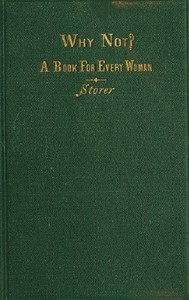
Why not? A book for every woman by Horatio Robinson Storer

(2 User reviews)   2784
By Ava Marino Posted on Jan 2, 2026
In Category - Expedition Notes
Storer, Horatio Robinson, 1830-1922 Storer, Horatio Robinson, 1830-1922
English
I just finished reading this 19th-century book written by a doctor, and wow, it's a complicated piece of history. Published in 1868, 'Why Not?' is not what you might expect from the title. It's not a book of encouragement. Instead, it's Dr. Horatio Storer's passionate argument against abortion, written directly for women of his time. Reading it today is like stepping into a time machine. You get to see the medical, moral, and social debates of the era laid bare, but from a perspective that can feel very alien and often unsettling to a modern reader. It's less of a story and more of a historical document that makes you think hard about how much has changed, and why.
Share

Read "Why not? A book for every woman by Horatio Robinson Storer" Online

This book is available in the public domain. Start reading the digital edition below.

START READING FULL BOOK
Instant Access    Mobile Friendly

Book Preview

A short preview of the book’s content is shown below to give you an idea of its style and themes.

himself upon the generous sympathy and forbearance of his readers. The Essay, when placed in the hands of the Committee, was accompanied by the following statement, which it may not be out of place to reproduce at the present time:-- "The writer, knowing nothing of the project to elicit a direct and effective appeal to women upon the subject of criminal abortion, until after it had been decided at the New York meeting,[1] has long been a member of the Association. He is aware, from personal observation, that induced miscarriage is of very frequent occurrence, and that its effects are to the last degree disastrous to the country at large. He has seen the change that has been effected in professional feeling upon the subject as to the need that this depopulation, or rather prevention of repopulation of the country, should be arrested, since the publication of the Report of the Association's Special Committee, which was appointed at Nashville in 1857. "It is, perhaps, presumptuous for him to undertake a task so strongly appealing to all one's eloquence, sympathy, and zeal, and for the proper performance of which there exist so many gentlemen in the profession better qualified than himself. He does it, however, as the passing traveller in distant lands, by casting his pebble upon the pile of similar contributions that mark a single wayside grave, helps raise a monument to warn of danger and to tell of crime, in the hope that this waif of his may, perchance, effect somewhat toward arousing the nation to the countless fœtal deaths intentionally produced each day in its midst, and to prevent them. "The Association has empowered the Prize Committee to award the premium of the present year to the best popular tract upon the subject of induced abortion. The writer presents the accompanying paper neither for fame nor for reward. It has been prepared solely for the good of the community. If it be considered by the Committee worthy its end, they will please adjudge it no fee, nor measure it by any pecuniary recompense. Were the finances of the Association such as to warrant it in more than the most absolutely necessary expenditures, yet would the approbation of the Committee, and of the profession at large, be more grateful to the writer than any tangible and therefore trivial reward. "It is a singular and appropriate coincidence that the action of the Association, originating as it did from Boston, in 1857, and recognizing in no uncertain language, alike by the resolutions that were formally adopted by the Louisville Convention, and by the memorial presented by its President to the different legislative assemblies and State Medical Societies of the Union, the necessity of a radical change as to the popular estimate of the crime,--should now culminate and become effective at a meeting of the Association in Boston, by an authorized appeal in behalf of the profession to the community, which alone makes and enforces the laws, till now a dead letter as regards abortion, and which alone commits, palliates, and suffers from the crime. It it is an equally striking and appropriate coincidence that the Chairman of the Committee, at whose hands the selection of that appeal must be made, though the Committee had been chosen for a general purpose before it had been decided by the Association to elicit essays upon this special subject, should be the physician who, in New England, first appreciated the frequency of criminal abortions, pointed out their true character, and denounced them. "If this Essay prove successful, its author only asks that the seal which...

This is a limited preview. Download the book to read the full content.

Let's be clear from the start: 'Why Not? A Book for Every Woman' is not a novel. There's no plot in the traditional sense. Think of it as a long, persuasive letter from a 19th-century surgeon to the women of America. Dr. Horatio Robinson Storer was a leading figure in the 'physicians' crusade' against abortion. In this book, he lays out his case, mixing medical opinions of the day with strong moral and religious arguments. He aims to convince women that ending a pregnancy is always wrong, dangerous, and a crime against society.

Why You Should Read It

This book is a powerful primary source. It doesn't just tell you what people believed in the 1860s; it shows you, in the author's own urgent words. Reading Storer's arguments—some based on outdated science, others on enduring philosophical questions—is fascinating and often jarring. It forces you to engage with a pivotal moment in the history of women's rights and medical ethics. You're not reading *about* history; you're reading the history itself, uncensored and raw.

Final Verdict

This isn't a book for casual entertainment. It's for readers who are curious about social history, the history of medicine, or the long road of reproductive rights. If you want to understand the roots of contemporary debates, this primary source offers essential, if difficult, context. Approach it as a historical artifact, not a guide, and be prepared for a challenging but illuminating read.


📚 Copyright Free

There are no legal restrictions on this material. Thank you for supporting open literature.

Michael Clark
2 months ago

Citation worthy content.

Anthony Lewis
1 year ago

I had low expectations initially, however the character development leaves a lasting impact. I couldn't put it down.
4
4 out of 5 (2 User reviews )

Add a Review

Your Rating *
There are no comments for this eBook.
You must log in to post a comment.
Log in


Related eBooks