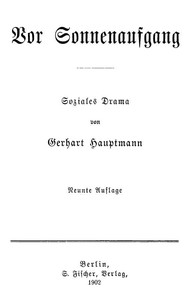
Vor Sonnenaufgang: Soziales Drama by Gerhart Hauptmann

(9 User reviews)   4334
By Ava Marino Posted on Nov 15, 2025
In Category - Expedition Notes
Hauptmann, Gerhart, 1862-1946 Hauptmann, Gerhart, 1862-1946
German
Ever wondered what happens when a city guy with big ideas crashes a country party? That's 'Vor Sonnenaufgang' (Before Sunrise). It's 1889, and young Alfred Loth rolls up to a Silesian village, ready to save the peasants from poverty. But the real drama isn't in the fields—it's in the home of his old friend, where new money from coal has poisoned everything. Loth falls for his friend's sister, Helene, who's trapped in this mess. The question is: Can his ideals survive a collision with this family's ugly secrets? This play started a revolution in German theater, and you can feel the shockwaves.
Share

Read "Vor Sonnenaufgang: Soziales Drama by Gerhart Hauptmann" Online

This book is available in the public domain. Start reading the digital edition below.

START READING FULL BOOK
Instant Access    Mobile Friendly

Book Preview

A short preview of the book’s content is shown below to give you an idea of its style and themes.

Vor Sonnenaufgang. Soziales Drama. 9. Auflage. Das Friedensfest. Eine Familienkatastrophe. 4.-5. Auflage. Einsame Menschen. Drama. 13.-14. Auflage. De Waber. Schauspiel aus den 40er Jahren. 2. Auflage. Originalausgabe. Die Weber. Schauspiel aus den 40er Jahren. 27.-28. Auflage. Übertragung. College Crampton. Komödie. 5.-6. Auflage. Bahnwärter Thiel. Der Apostel. Novellistische 5.-6. Auflage. Studien. Der Biberpelz. Eine Diebskomödie. 7.-8. Auflage. Hannele. Eine Traumdichtung. Illustriert (vergriffen). Hanneles Himmelfahrt. Eine Traumdichtung. 9.-10. Auflage. Florian Geyer. 5.-6. Auflage. Die versunkene Glocke. Ein deutsches Märchendrama. 49.-52. Auflage. Fuhrmann Henschel. Schauspiel. Originalausgabe. 13.-16. Auflage. Fuhrmann Henschel. Schauspiel. Übertragung. 9.-12. Auflage. Schluck und Jau. Spiel zu Scherz und Schimpf. 8.-10. Auflage. Michael Kramer. Drama. 9.-10. Auflage. Vor Sonnenaufgang Soziales Drama von Gerhart Hauptmann Neunte Auflage Berlin, S. Fischer, Verlag, 1902 Sowohl Aufführungs- als Nachdrucks- und Uebersetzungsrecht vorbehalten. Den Bühnen gegenüber Manuskript. Die Aufführung dieses Dramas fand am 20. Oktober statt in den Räumen des Lessing-Theaters, veranstaltet vom Verein »Freie Bühne«. Ich benutze den Anlaß der Herausgabe einer neuen Auflage, um aus vollem Herzen den Leitern dieses Vereins insgesammt, in Sonderheit aber den Herren Otto Brahm und Paul Schlenther zu danken. Möchte es die Zukunft erweisen, daß sie sich, indem sie, kleinlichen Bedenken zum Trotz, einem aus reinen Motiven heraus entstandenen Kunstwerk zum Leben verhalfen, um die _deutsche_ Kunst verdient gemacht haben. Charlottenburg, den 26. Oktober 1889. Gerhart Hauptmann. Handelnde Menschen. Besetzung bei der ersten Aufführung. Krause, Bauerngutsbesitzer Hans Pagay. Frau Krause, seine zweite Frau Louise v. Pöllnitz. Helene, } Elsa Lehmann. Martha, } Krause's Töchter erster Ehe *** Hoffmann, Ingenieur, verheirathet mit Martha Gustav Kadelburg. Wilhelm Kahl, Neffe der Frau Krause Carl Stallmann. Frau Spiller, Gesellschafterin der Frau Krause Ida Stägemann. Alfred Loth Theodor Brandt. Dr. Schimmelpfennig Franz Guthery. Beibst, Arbeitsmann auf Krause's Gut Paul Pauly. Guste, } Sophie Berg. Liese, } Mägde auf Krause's Gut Clara Hahn. Marie, } Antonie Ziegler. Baer, genannt Hopslabaer Ferdinand Meyer. Eduard, Hoffmann's Diener Edmund Schmasow. Miele, Hausmädchen bei Frau Krause Helene Schüle. Die Kuschenfrau Marie Gundra. Golisch, genannt Gosch. Kuhjunge Georg Baselt. Ein Packetträger *** Erster Akt. Das Zimmer ist niedrig; der Fußboden mit guten Teppichen belegt. Moderner Luxus auf bäuerische Dürftigkeit gepfropft. An der Wand hinter dem Eßtisch ein Gemälde, darstellend einen vierspännigen Frachtwagen, von einem Fuhrknecht in blauer Blouse geleitet. * * * * * Miele, eine robuste Bauernmagd mit rothem, etwas stumpfsinnigem Gesicht; sie öffnet die Mittelthür und läßt Alfred Loth eintreten. Loth ist mittelgroß, breitschultrig, untersetzt, in seinen Bewegungen bestimmt, doch ein wenig ungelenk; er hat blondes Haar, blaue Augen und ein dünnes, lichtblondes Schnurrbärtchen, sein ganzes Gesicht ist knochig und hat einen gleichmäßig ernsten Ausdruck. Er ist ordentlich, jedoch nichts weniger als modern gekleidet. Sommerpaletot, Umhängetäschchen, Stock. Miele. Bitte! Ich werde den Herrn Inschinnär glei ruffen. Wolln Sie nich Platz nehmen?! Die Glasthür zum Wintergarten wird heftig aufgestoßen; ein Bauernweib, im Gesicht blauroth vor Wuth, stürzt herein. Sie ist nicht viel besser als eine Waschfrau gekleidet. Nackte, rothe Arme, blauer Kattunrock und Mieder, rothes punktirtes Brusttuch. Alter: Anfang 40, Gesicht hart, sinnlich, bösartig. Die ganze Gestalt sonst gut conservirt. Frau Krause (schreit). Ihr Madel!! ... Richtig! ... Doas Loster vu Froovulk! ... Naus! mir gahn nischt! ... (Halb zu Miele, halb zu Loth.) A koan orbeita, a hoot Oarme. Naus! hier gibbt's nischt! Loth. Aber Frau ... Sie werden doch ... ich ... ich heiße Loth, bin ... wünsche zu ... habe auch nicht die Ab.... Miele. A wull ock a Herr Inschinnär sprechen. Frau Krause. Beim Schwiegersuhne batteln: doas kenn' mer schunn. -- A hoot au nischt, a hoot's au ock vu ins, nischt iis seine! (Die Thür rechts wird aufgemacht. Hoffmann steckt den Kopf heraus.) Hoffmann....

This is a limited preview. Download the book to read the full content.

The Story

Alfred Loth, a bright-eyed social reformer, visits the rural estate of his old college buddy, Hoffmann. Hoffmann struck it rich when coal was discovered on his land. Loth thinks he's coming to study the local workers' conditions. What he walks into is a different kind of disaster.

The money has ruined Hoffmann's family. His wife is an alcoholic, his father-in-law is a lecherous drunk, and the house is full of shame. The only light in the place is Hoffmann's sister-in-law, Helene. She's young, smart, and desperate to escape. She sees Loth as her savior. They connect instantly, dreaming of a life away from the corruption. But when Loth learns the full, ugly truth about the family's inherited sickness and moral decay, he faces an impossible choice: follow his rigid principles or follow his heart.

Why You Should Read It

This isn't a dry history lesson. Hauptmann throws you into this tense, claustrophobic house and lets you feel the walls closing in on Helene. You'll get angry at the hypocrisy of the 'new rich' and ache for her hopeless situation. Loth is frustrating but real—a man so committed to an idea that he might just break something precious. The play moves like a slow-burn thriller. You keep hoping for a way out, right up to the devastating final scene. It's about the cost of progress and how principles can sometimes hurt the very people you want to protect.

Final Verdict

Perfect for anyone who loves character-driven stories where society itself is the villain. If you liked the intense family dramas of Ibsen or the gritty realism of later writers, this is your essential starting point. It's a short, powerful punch of a play that proves stories about social issues don't have to be boring—they can be heartbreaking, urgent, and incredibly human.


🔖 Community Domain

There are no legal restrictions on this material. It is now common property for all to enjoy.

Matthew Harris
1 year ago

I didn't expect much, but the plot twists are genuinely surprising. Absolutely essential reading.

Karen Wilson
1 year ago

Simply put, the content flows smoothly from one chapter to the next. I would gladly recommend this title.

David Lewis
8 months ago

I have to admit, it manages to explain difficult concepts in plain English. Don't hesitate to start reading.

Deborah Walker
11 months ago

Recommended.

4.5
4.5 out of 5 (9 User reviews )

Add a Review

Your Rating *
There are no comments for this eBook.
You must log in to post a comment.
Log in


Related eBooks