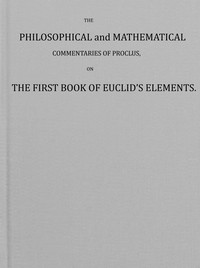
The philosophical and mathematical commentaries of Proclus on the first book of…

(0 User reviews)   1806
By Ava Marino Posted on Jan 2, 2026
In Category - Expedition Notes
Proclus, 412-485 Proclus, 412-485
English
Ever wonder how ancient thinkers made sense of the universe before modern science? This isn't just a dusty old commentary—it's a 1,500-year-old conversation. Proclus, a philosopher from the late Roman Empire, is trying to save Plato's ideas as his world crumbles around him. While barbarians are literally at the gates, he's writing intricate arguments about geometry and the nature of reality. The real mystery here is the human mind itself: why would someone spend years analyzing Euclid's basic shapes when society is falling apart? It’s a surprisingly personal look at what we cling to when everything else is uncertain.
Share

Read "The philosophical and mathematical commentaries of Proclus on the first book of…" Online

This book is available in the public domain. Start reading the digital edition below.

START READING FULL BOOK
Instant Access    Mobile Friendly

Book Preview

A short preview of the book’s content is shown below to give you an idea of its style and themes.

LEIGH and CO.; G. NICOL; R. FAULDER; and T. and J. EGERTON. 1792. [Price Two Guineas in Boards.] _Extracts from Curiosities of Literature._ Second Edition. Printed for Murray. Page 385. Mr. _T. TAYLOR_, the Platonic Philosopher and _the modern Plethon_, consonant to that philosophy, professes Polytheism.[1] The Reader is requested to correct the following Errors. Page 4. of the Dissertation, Vol. I. line 8. for _admitted_, read _omitted_. Page 16. line 8. for _from_, read _form_. Page 51. Vol. I. of the Commentaries, line 16. instead of _They are surely not the_, &c. read _For surely it cannot be said that there are_, &c. Line 17. for _but we_, read _but that we_. And line 19. for _is by much prior to_, read _is by a much greater priority_. Vol. II. page 18. line 26. for _and one is_, read _and one part is_. And line 27. for _another_, read _the other_. Page 114. line 13. for _The angle_, read _Let the angle_; and instead of _is bisected_, in the same line, read _be bisected_. Page 411. line 2. for _is filled with intellect_, read _fills intellect_. And line 3. for _it also participates_, read _also it participates_. TO THE SACRED MAJESTY OF TRUTH. PREFACE. The design of the present work is to bring us acquainted with the nature and end of Mathematics in general, and of Geometry in particular: and in the execution of this design our Author has displayed an uncommon elegance of composition, and a most valuable store of recondite learning. He is not content with every where unfolding the full, and most accurate meaning of Euclid; but he continually rises in his discourse, and leads us into the depths of the Pythagoric and Platonic philosophy. We are surprised to find an use in Geometry, which at present it is by no means suspected to afford. For who would conceive that it is the genuine passage to true theology, and the vestibule of divinity? This, indeed, is by no means the case when it is studied for lucre, and applied to mechanical purposes; for then the soul is neither elevated nor enlightened; but degraded and filled with material darkness. Hence these Commentaries are alone valuable to the liberal part of mankind, who look beyond _sense_ for certainty; and who prefer things desirable for their own sakes, before such as minister to the necessities of life. The translation of this work is attended with great difficulty and labour; not only from the sense of the philosopher, which is always profound, and frequently obscure, but from the great incorrectness of the Greek edition, in which, exclusive of numberless typographical errors, entire sentences, essential to the connection, are frequently omitted; and in one place two pages of the Latin translation are wanting in the original, as will be shewn in our following notes. Indeed, the Latin translation of Francis Barocius the Venetian, (Patav. 1560.) which was made from a variety of manuscripts, is inconceivably valuable; for the diagrams, so necessary to a work of this kind, but which are omitted in the Greek, are here inserted; and the version is every where faithful, and sufficiently perspicuous to those who are conversant in the ancient philosophy. Barocius justly cautions the reader not to compare his version with the printed Greek, which he observes is rather lacerated than printed; as indeed, without his translation, it is impossible for any one to read the half of this invaluable work, even though he should be as perfect in Greek as in his native tongue. If I had not, therefore, fortunately acquired this translation, which...

This is a limited preview. Download the book to read the full content.

Okay, so there's no traditional "plot" with characters and action. Instead, the "story" is Proclus's deep dive into Euclid's Elements, the book that taught geometry to the ancient world. He's not just explaining the math. He's asking bigger questions: What does a perfect triangle represent? How do abstract ideas connect to the physical world? He builds a whole philosophical system from the ground up, starting with a simple line and point.

Why You Should Read It

You might think, "Geometry? Pass." But stick with me. This book shows how philosophy, math, and spirituality were totally intertwined for ancient thinkers. Proclus sees the universe as a living, thinking thing, and geometry is its language. Reading his passionate defense of Plato's ideas feels intimate. You get a real sense of a brilliant man trying to preserve a whole way of thinking as history moves on without him. It’s less about memorizing theorems and more about watching a master thinker at work.

Final Verdict

This is a niche pick, but a rewarding one. It's perfect for history buffs who love primary sources, or anyone curious about how people built complex worldviews long before the scientific method. If you enjoyed books like The Swerve or are fascinated by the end of the classical world, Proclus offers a front-row seat. It's not a beach read, but for the right reader, it’s a captivating window into a lost intellectual universe.


🔓 Copyright Free

This digital edition is based on a public domain text. Distribute this work to help spread literacy.
There are no reviews for this eBook.

0
0 out of 5 (0 User reviews )

Add a Review

Your Rating *
There are no comments for this eBook.
You must log in to post a comment.
Log in


Related eBooks