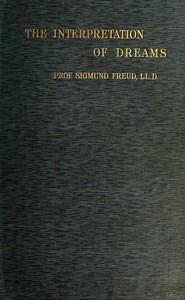
The Interpretation of Dreams by Sigmund Freud

(5 User reviews)   4679
By Ava Marino Posted on Jan 2, 2026
In Category - Expedition Notes
Freud, Sigmund, 1856-1939 Freud, Sigmund, 1856-1939
English
Ever wake up from a dream so weird you just have to tell someone about it? What if I told you that weird dream about showing up to work in your pajamas or flying over your childhood home actually means something? That's the wild idea at the heart of Sigmund Freud's 'The Interpretation of Dreams.' Forget dream dictionaries with simple symbols. Freud argues that our dreams are a secret, scrambled broadcast from our unconscious mind, packed with hidden wishes, fears, and memories we've shoved out of our waking thoughts. Reading this book is like getting a backstage pass to your own brain. It's challenging, sometimes controversial, but it will forever change how you think about that strange movie that plays in your head every night. Ready to become a detective of your own dreams?
Share

Read "The Interpretation of Dreams by Sigmund Freud" Online

This book is available in the public domain. Start reading the digital edition below.

START READING FULL BOOK
Instant Access    Mobile Friendly

Book Preview

A short preview of the book’s content is shown below to give you an idea of its style and themes.

they refuse to follow me into this territory of dream investigation. Likewise, the material used in this book to illustrate the rules of dream interpretation, drawn chiefly from dreams of my own which have been depreciated and outstripped by events, have in the revision shown a persistence which resisted substantial changes. For me, indeed, the book has still another subjective meaning which I could comprehend only after it had been completed. It proved to be for me a part of my self-analysis, a reaction to the death of my father—that is, to the most significant event, the deepest loss, in the life of a man. After I recognised this I felt powerless to efface the traces of this influence. For the reader, however, it makes no difference from what material he learns to value and interpret dreams. BERCHTESGADEN, Summer of 1908. PREFACE TO THE THIRD EDITION Whereas a period of nine years elapsed between the first and second editions of this book, the need for a third edition has appeared after little more than a year. I have reason to be pleased with this change; but, just as I have not considered the earlier neglect of my work on the part of the reader as a proof of its unworthiness, I am unable to find in the interest manifested at present a proof of its excellence. The progress in scientific knowledge has shown its influence on the _Interpretation of Dreams_. When I wrote it in 1899 the “Sexual Theories” was not yet in existence, and the analysis of complicated forms of psychoneuroses was still in its infancy. The interpretation of dreams was destined to aid in the psychological analysis of the neuroses, but since then the deeper understanding of the neuroses has reacted on our conception of the dream. The study of dream interpretation itself has continued to develop in a direction upon which not enough stress was laid in the first edition of this book. From my own experience, as well as from the works of W. Stekel and others, I have since learned to attach a greater value to the extent and the significance of symbolism in dreams (or rather in the unconscious thinking). Thus much has accumulated in the course of this year which requires consideration. I have endeavoured to do justice to this new material by numerous insertions in the text and by the addition of footnotes. If these supplements occasionally threaten to warp the original discussion, or if, even with their aid, we have been unsuccessful in raising the original text to the _niveau_ of our present views, I must beg indulgence for the gaps in the book, as they are only consequences and indications of the present rapid development of our knowledge. I also venture to foretell in what other directions later editions of the _Interpretation of Dreams_—in case any should be demanded—will differ from the present one. They will have, on the one hand, to include selections from the rich material of poetry, myth, usage of language, and folk-lore, and, on the other hand, to treat more profoundly the relations of the dream to the neuroses and to mental diseases. Mr. Otto Rank has rendered me valuable service in the selection of the addenda and in reading the proof sheets. I am gratefully indebted to him and to many others for their contributions and corrections. VIENNA, Spring of 1911. TRANSLATOR’S PREFACE Since the appearance of the author’s _Selected Papers on Hysteria and other Psychoneuroses_, and _Three Contributions to the Sexual Theory_,[A] much has been said and written about Freud’s works. Some of our...

This is a limited preview. Download the book to read the full content.

Okay, let's be clear: this isn't a novel with a plot. There's no hero's journey. The 'story' here is the journey of an idea. Freud presents his central argument: dreams are not random nonsense. They are the 'royal road to the unconscious.' He says that every dream is a disguised fulfillment of a repressed wish—often something from childhood that our conscious, polite adult selves would never admit to.

The Story

The book walks us through his theory. He explains how our minds use 'dream work' to censor these uncomfortable wishes. Symbols, condensation (mashing multiple ideas into one image), and displacement (shifting emotion from the real subject to something else) are the mind's tools for hiding the truth. Freud uses examples from his own dreams, his patients', and even historical figures to build his case. A big part of the book is him trying to convince a skeptical scientific community (and maybe himself) that this isn't just wild speculation.

Why You Should Read It

You should read it because, love it or hate it, Freud's ideas are baked into our culture. Ever called a mistake a 'Freudian slip'? That started here. The book gives you the source code for modern psychology, talk therapy, and how we think about ourselves. It's fascinating to watch a brilliant, determined mind build a whole new world from the ground up, using dreams as his blueprint. It's also deeply personal—Freud analyzes his own dreams about professional insecurity and family, which makes his theory feel human, not just clinical.

Final Verdict

This is for the curious reader who likes big ideas. It's perfect for anyone interested in psychology's origins, the power of storytelling (even the stories we tell ourselves while asleep), or who just wants to understand why we are the way we are. It's not a light read—you have to wrestle with it sometimes—but the payoff is a completely new lens for viewing your own inner life. Just be prepared to disagree with parts of it; that's half the fun.


🔖 License Information

This is a copyright-free edition. It is now common property for all to enjoy.

Brian Martin
1 year ago

Used this for my thesis, incredibly useful.

Carol Thomas
1 year ago

This book was worth my time since the content flows smoothly from one chapter to the next. This story will stay with me.

Dorothy Perez
1 year ago

This is one of those stories where it provides a comprehensive overview perfect for everyone. Highly recommended.

Sandra Perez
1 year ago

I was skeptical at first, but the flow of the text seems very fluid. I couldn't put it down.

Ava Sanchez
9 months ago

I stumbled upon this title and the depth of research presented here is truly commendable. Thanks for sharing this review.

4.5
4.5 out of 5 (5 User reviews )

Add a Review

Your Rating *
There are no comments for this eBook.
You must log in to post a comment.
Log in


Related eBooks