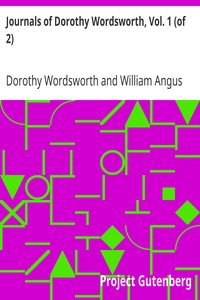
Journals of Dorothy Wordsworth, Vol. 1 (of 2) by Dorothy Wordsworth

(3 User reviews)   4131
By Ava Marino Posted on Jan 2, 2026
In Category - Expedition Notes
Wordsworth, Dorothy, 1771-1855 Wordsworth, Dorothy, 1771-1855
English
Have you ever wondered what it was like to live inside a genius's world? Dorothy Wordsworth's journals aren't about her famous brother William's poems—they're about everything he left out. This is the raw, unedited backstage pass to the Romantic movement. We get the muddy walks, the endless cups of tea, the worry over money, and the sudden, breathtaking moments where the ordinary English landscape becomes pure magic. The real story here isn't in the published verses, but in the quiet, fiercely observant woman who saw it all first and wrote it down for herself. It's a slow-burn mystery of how creativity really works.
Share

Read "Journals of Dorothy Wordsworth, Vol. 1 (of 2) by Dorothy Wordsworth" Online

This book is available in the public domain. Start reading the digital edition below.

START READING FULL BOOK
Instant Access    Mobile Friendly

Book Preview

A short preview of the book’s content is shown below to give you an idea of its style and themes.

Tour on the Continent made in 1820 (and of a similar one written by Mrs. Wordsworth), as well as short records of subsequent visits to Scotland and to the Isle of Man, were printed in the same volume. None of these, however, were given in their entirety; nor is it desirable now to print them _in extenso_, except in the case of the _Recollections of a Tour made in Scotland_ in 1803. All the Journals contain numerous trivial details, which bear ample witness to the "plain living and high thinking" of the Wordsworth household--and, in this edition, samples of these details are given--but there is no need to record all the cases in which the sister wrote, "To-day I mended William's shirts," or "William gathered sticks," or "I went in search of eggs," etc. etc. In all cases, however, in which a sentence or paragraph, or several sentences and paragraphs, in the Journals are left out, the omission is indicated by means of asterisks. Nothing is omitted of any literary or biographical value. Some persons may think that too much has been recorded, others that everything should have been printed. As to this, posterity must judge. I think that many, in future years, will value these Journals, not only as a record of the relations existing between Wordsworth and his sister, his wife, her family and his friends, but also as an illustration of the remarkable literary brotherhood and sisterhood of the period. Coming now to details. I I do not know of any Journal written at Racedown, and I do not think that Dorothy kept one while she and her brother lived in Dorsetshire. In July 1797 they took up their residence at Alfoxden; but, so far as is known, it was not till the 20th of January 1798 that Dorothy began to write a Journal of her own and her brother's life at that place. It was continued uninterruptedly till Thursday, 22nd May 1798. It gives numerous details as to the visits of Coleridge to Alfoxden, and the Wordsworths' visits to him at Nether-Stowey, as well as of the circumstances under which several of their poems were composed. Many sentences in the Journal present a curious resemblance to words and phrases which occur in the poems; and there is no doubt that, as brother and sister made use of the same note-book--some of Wordsworth's own verses having been written by him in his sister's journal--the copartnery may have extended to more than the common use of the same MS. The archaic spellings which occur in this Journal are retained; but inaccuracies--such as Bartelmy for Bartholemew, Crewkshank for Cruikshank--are corrected. In the edition of 1889 the words were printed as written in MS.; but it is one thing to reproduce the _bona fide_ text of a journal, or the _ipsissima verba_ of a poet, and quite another to reproduce the incorrect spellings of his sister. II From the Journal of the days spent at Hamburg in 1798--when the Wordsworths were on their way to Goslar, and Coleridge to Ratzeburg--only a few extracts are given, dating from 14th September to 3rd October of that year. These explain themselves. III-VI Of the Grasmere Journals much more is given, and a great deal that was omitted from the first volume of the _Life of Wordsworth_ in 1889, is now printed. To many readers this will be by far the most interesting section of all Dorothy Wordsworth's writings. It not only contains exquisite descriptions of Grasmere and its district--a most felicitous record of the changes of the seasons and the progress of the...

This is a limited preview. Download the book to read the full content.

Forget what you think you know about the Romantic poets. Dorothy Wordsworth's Journals throws open the door to the chaotic, creative, and often very damp household at Dove Cottage. This isn't a plotted novel; it's a daily record from 1798 to 1803, the very years her brother William was writing his most famous work. We follow Dorothy as she manages the household, takes long walks with William and Coleridge, copies out poems, and observes everything with a painter's eye.

Why You Should Read It

Reading Dorothy is like getting a secret key to a famous era. You see the reality behind the poetry. William sees a "host of golden daffodils"; Dorothy notes exactly how they "tossed and reeled and danced" in the wind weeks earlier. Her writing is immediate and sensory. You feel the cold rain, smell the peat fire, and share her quiet joy in a garden blossom. She shows us that great art doesn't spring from nowhere—it's built on a foundation of daily life, deep observation, and a sibling bond that was a creative engine.

Final Verdict

Perfect for anyone who loves biography, nature writing, or peeking behind the historical curtain. If you enjoy the quiet drama of everyday life and stunning descriptions of the natural world, you'll find a friend in Dorothy. It's not a fast read, but a deeply rewarding one. You'll never read a Wordsworth poem the same way again.


📚 License Information

This book is widely considered to be in the public domain. You do not need permission to reproduce this work.

Jennifer Scott
1 week ago

I came across this while browsing and the clarity of the writing makes this accessible. Exactly what I needed.

Sarah Thompson
6 months ago

If you enjoy this genre, it manages to explain difficult concepts in plain English. I will read more from this author.

Edward Martin
11 months ago

Enjoyed every page.

4
4 out of 5 (3 User reviews )

Add a Review

Your Rating *
There are no comments for this eBook.
You must log in to post a comment.
Log in


Related eBooks