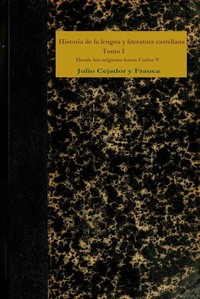
Historia de la lengua y literatura castellana, Tomo 1 : Desde los orígenes…

(7 User reviews)   5282
By Ava Marino Posted on Dec 26, 2025
In Category - Historical Travel
Cejador y Frauca, Julio, 1864-1927 Cejador y Frauca, Julio, 1864-1927
Spanish
Ever wonder how Spanish went from a local dialect to the language of an empire? Julio Cejador y Frauca's first volume is like a detective story for words. It's not just a dry history book—it's a quest to find the very first whispers of written Spanish, buried in old monasteries and legal documents. He tracks how the language evolved from its Latin roots, through the messy, creative Middle Ages, shaped by kings, poets, and everyday people. If you love Spanish or are just curious about where words come from, this book feels like uncovering a hidden origin story for everything you say.
Share

Read "Historia de la lengua y literatura castellana, Tomo 1 : Desde los orígenes…" Online

This book is available in the public domain. Start reading the digital edition below.

START READING FULL BOOK
Instant Access    Mobile Friendly

Book Preview

A short preview of the book’s content is shown below to give you an idea of its style and themes.

escrito en MAYÚSCULAS y las palabras en negrita se indican =así=. Además, una letra precedida por el signo “^” indica que esa letra es un superíndice. Por ejemplo ^e representa la letra “e” en tamaño más pequeño que la escritura del resto del texto, y se encuentra ligeramente por encima de la línea de escritura. En la obra original aparecen letras o conjunto de letras con un signo diacrítico que muestra una línea horizontal (macrón) en la parte superior de esas letras. Algunos de esos signos no pueden representarse en la versión sin formatear y en consecuencia están representados con la marca [=texto]; es decir que ese signo representa la palabra “texto” con una línea horizontal superior sobre dicha palabra. En el texto original en algunas partes se emplea el signo del antiguo et latino. Para esta transcripción se ha utilizado el 2 invertido (ᘔ) para su representación. Para el texto escrito por Cejador y Frauca, el criterio utilizado para llevar a cabo esta transcripción ha sido el de respetar las reglas de la Real Academia Española, vigentes cuando la presente edición de la obra fue publicada. El lector interesado puede consultar el Mapa de Diccionarios Académicos de la Real Academia Española. Para el texto citado de otros autores, el criterio fue privilegiar que coincidiese con el texto que figura en la imagen utilizada para llevar a cabo la transcripción. No se han modificado evidentes errores tipográficos ni de ortografía en esos textos, estimando que la intención de Cejador y Frauca fue de preservar la grafía original. Es por eso que se encontrarán inconsistencias en la forma que están escritos varios vocablos. Se ha incorporado también la Fe de Erratas incluida al final en la obra impresa original, pero los errores indicados en la misma no se han corregido. El transcriptor ha imcluido un Índice y ha movido la lista de láminas presentadas en la edición impresa al principio de la obra. El transcriptor ha modificado la imagen de la cubierta original y la ha puesto en el dominio público. * * * * * HISTORIA DE LA LENGUA Y LITERATURA CASTELLANA (DESDE LOS ORÍGENES HASTA CARLOS V) POR D. JULIO CEJADOR Y FRAUCA CATEDRÁTICO DE LA LENGUA Y LITERATURA LATINAS DE LA UNIVERSIDAD CENTRAL [Ilustración] MADRID TIP. DE LA "REV. DE ARCH., BIBL. Y MUSEOS" _Olózaga, 1.--Teléfono 3.185._ 1915 ÍNDICE Pág. CARTA A GUISA DE PRÓLOGO v NACIMIENTO DEL ROMANCE Y DE LA LITERATURA POPULAR 1 ÉPOCA ROMANA (SIGLOS I-IV) 67 ÉPOCA VISIGÓTICA (SIGLOS V-VII) 95 ÉPOCA ARÁBIGA (SIGLOS VIII-XI) 109 ÉPOCA DEL NACIMIENTO DEL IDIOMA LITERARIO Y DE LA LITERATURA ERUDITA (SIGLO XII) 120 ÉPOCA DE ALFONSO "EL SABIO" (SIGLO XIII) 177 ÉPOCA DIDÁCTICA (SIGLO XIV) 216 ÉPOCA DE DON JUAN EL II LA POESÍA LÍRICA CORTESANA Y LOS ALBORES DEL RENACIMIENTO (PRIMERA MITAD DEL SIGLO XV HASTA 1454) 267 ÉPOCA DE LOS REYES CATÓLICOS EL ARTE POPULAR. EL RENACIMIENTO Y LOS HUMANISTAS (SEGUNDA MITAD DEL SIGLO XV, 1454 HASTA 1516) 335 AUTORES Y OBRAS ANÓNIMAS 495 ERRATAS 506 COLOCACIÓN DE LAS LÁMINAS Pág. Lucio Anneo Séneca (Berlín, Altes Museum) 76 San Beato, _Comentario del Apocalipsis_ (Catedral de Gerona) 112 Cofre del Cid (Catedral de Burgos).--Sepulcro del Cid (San Pedro de Cardeña) 166 Momia de D. Rodrigo Ximénez de Rada. (Discurso de D. Enrique de Aguilera y Gamboa, Marqués de Cerralbo, en su recepción de la Real Academia de la Historia, Madrid, 1908) 188 Alfonso X (Ms. de la _Crónica general_ de la época, Biblioteca Real) 194 _Crónica de Don Jaime el Conquistador_ (siglo XIV, Códice de Poblet, Biblioteca de San Juan) 224 Sepulcro de D. Juan II...

This is a limited preview. Download the book to read the full content.

Julio Cejador y Frauca's book isn't about a single plot, but about tracing a family tree. His 'story' is the search for the birth and awkward teenage years of the Spanish language.

The Story

Cejador starts at the very beginning, with the messy breakdown of Latin after the Roman Empire. He then goes on a literary scavenger hunt. He pieces together the first shaky sentences written in what we'd recognize as Spanish, found in glosses in the margins of Latin texts and in early legal charters. The book follows the language as it grows stronger, showing how it was shaped by epic poems sung in courts, by the intellectual work in monasteries, and by the political needs of emerging kingdoms.

Why You Should Read It

What makes this old book still interesting is Cejador's obvious passion. He's not just listing facts; he's making an argument for why certain texts matter. Reading it, you get a real sense of discovery. You see language not as something fixed, but as a living thing that changes with wars, migrations, and art. It connects dots between history class and the words you use every day.

Final Verdict

This is for the curious reader who loves language, history, or both. It's perfect for students of Spanish, book lovers interested in medieval literature, or anyone who's ever asked, 'Why do we say it that way?' Be warned: it's a scholarly work from another era, so it requires some patience. But if you stick with it, you'll gain a deep appreciation for the incredible journey of a few words on a parchment to a global language.


🔖 Legal Disclaimer

There are no legal restrictions on this material. Feel free to use it for personal or commercial purposes.

Betty Martin
11 months ago

Great read!

Liam Garcia
8 months ago

Finally found time to read this!

Andrew Brown
6 months ago

From the very first page, the atmosphere created is totally immersive. I would gladly recommend this title.

Karen Rodriguez
7 months ago

This is one of those stories where the arguments are well-supported by credible references. Exceeded all my expectations.

Dorothy Harris
7 months ago

From the very first page, the author's voice is distinct and makes complex topics easy to digest. Exceeded all my expectations.


5
5 out of 5 (7 User reviews )

Add a Review

Your Rating *
There are no comments for this eBook.
You must log in to post a comment.
Log in


Related eBooks