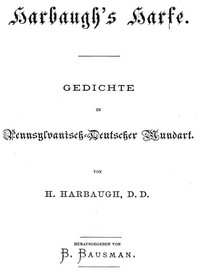
Harbaugh's Harfe: Gedichte in Pennsylvanisch-Deutscher Mundart by Henry Harbaugh

(5 User reviews)   5475
By Ava Marino Posted on Nov 15, 2025
In Category - Historical Travel
Harbaugh, Henry, 1817-1867 Harbaugh, Henry, 1817-1867
German
Ever wonder what it was like to think and feel in a language that's almost vanished? This is more than a book of old poems. It's a time capsule. Henry Harbaugh, a 19th-century pastor, wrote these verses in the everyday Pennsylvania Dutch dialect of his community. The real story isn't just in the words, but in the quiet struggle it captures: a whole world of farmers, families, and faith, speaking in a tongue that was already starting to fade, trying to hold onto something precious before it slipped away. Reading it feels like listening in on a secret conversation from another America.
Share

Read "Harbaugh's Harfe: Gedichte in Pennsylvanisch-Deutscher Mundart by Henry Harbaugh" Online

This book is available in the public domain. Start reading the digital edition below.

START READING FULL BOOK
Instant Access    Mobile Friendly

Book Preview

A short preview of the book’s content is shown below to give you an idea of its style and themes.

mitwirkten, sei hiermit herzlich gedankt. Namentlich Herrn E. D. LEISENRING, B. F. TREXLER, Pastor S. K. BROBST und Pastor A. J. G. DUBBS von Allentown, sowie Hrn. J. M. BECK vom „Reading Adler,” der es unternahm die Schreibweise zu ordnen und der die Wörter-Tabelle im Anhang des Buches bereitete. Die Holzschnitte sind alle nach Original-Zeichnungen angefertigt. Das alt Schulhaus, Die alte Miehl, die HARBAUGH’sche Heimath und Der alte Feierheerd wurden an Ort und Stelle, in Franklin County, von Herrn J. A. BECK von Harrisburg skizzirt. Die Bilder zum Kerchegang in alter Zeit und Heemweh zeichnete Herr DAN. DEVLIN von Reading, Pa. Der Ertrag des Verkaufs dieses Buches soll Dr. HARBAUGH’s Familie zu gut kommen. Diese Harfe giebt eine Darstellung des Volks- und Familien-Lebens der Deutsch-Pennsylvanier. Von der Wiege bis zum Grabe, aus der Familie, Schule und Kirche wird manches liebliche Bild gemalt. Möchte die lieben Leser bitten „Die Harfe” nicht an die Weiden zu hängen, sondern recht oft ihre schönen Klänge im Kreise der Familie ertönen zu lassen. B. BAUSMAN. _Reading, Pa., Mai, 1870._ Inhalts-Verzeichniss. _Seite_ Einleitung, 7 Zum A’denke an Dr. Heinrich Harbaugh, 9 Das alt Schulhaus an der Krick, 13 Die neie Sort Dschent’lleit, 21 Der Belsnickel, 23 Der alte Feierheerd, 25 Die Schlofschtub, 31 Der reiche Herr im Deich, 37 Das Krischkindel, 39 Die alt Miehl, 45 Busch un Schtedtel, 51 Der Rejeboge, 53 Der Pihwie, 59 Der Kerchegang in alter Zeit, 61 Will widder Buwele sei’, 65 Lah Bisness, 69 Heemweh, 77 The Old School-House at the Creek, 87 The Old-Time Hearth-Fire, 95 Home-Sickness, 99 The Old Sleeping Room, 106 Wortverzeichniss, 111 Verzeichniss der Bilder. Wohnhaus der Eltern Harbaugh’s, Vorderseite. Das Alt Schulhaus an der Krick, _Seite_ 12 Der Alte Feierheerd, 27 Die Alt Miehl, 44 Der Kerchegang in Alter Zeit, 63 Heemweh, 82 Einleitung. Heinrich Harbaugh wurde den 28. October, 1817, nahe bei Waynsboro’, Franklin County, Pa., geboren. In 1736 kam sein Ur-Grossvater, YOST HARBAUGH, aus der Schweiz nach Amerika. Er kaufte sich eine Bauerei „drei Meilen oberhalb der Maxatawny Creek,” in Maxatawny Township, Berks County, Pa. Aus diesem Stamm wuchsen die Zweige der zahlreichen HARBAUGH Familie in Amerika. HEINRICH HARBAUGH’s Vater, GEORGE HARBAUGH, war ein einfacher fleissiger Bauer. Seine Mutter war eine geborne Schneider, von Lancaster County, Pa. Beide Eltern gehörten zur Reformirten Kirche, in welchem Glauben sie ihre Kinder treu zu erziehen suchten. Sie hatten zwölf Kinder, wovon HEINRICH das zehnte war. Von früher Jugend an hatte er eine Vorliebe zum Studiren. Er sollte Bauer oder Handwerker werden; allein er selbst fühlte sich zum Predigtamt berufen. Er blieb seinen Eltern getreu, und arbeitete fleissig als ein Ackersmann. Dabei aber liebte er Bücher, und sparte jeden Cent, um dieselben zu kaufen. Damals hatte man blos während etlichen Winter-Monaten Schule. In der übrigen Zeit studirte er nach Gelegenheit. Er hatte den Gebrauch, ein Buch in seiner Tasche nachzutragen. Beim Pflügen, während er die Pferde in der Furche ruhen liess, and Mittags während sie ihr Futter frassen, las er fleissig. Das Schulhaus für jene Gegend stand neben einem Bach, eine kurze Strecke von seiner Heimath. Seine Schul-Erfahrungen und Erinnerungen, bewogen ihn das „Schulhaus an der Krick” zu schreiben. Endlich fühlte er sich durch einen Gewissens-Zwang bewogen, sich dem Studium zu widmen. Allein dazu fehlten ihm die Mittel. Er entschloss sich am Schreinerhandwerk zu arbeiten, welches er theilweise gelernt hatte, um sich das nöthige Geld zu verdienen. Sein Scheiden von dem elterlichen Hause wird in einem Bilde dieses Buches dargestellt. Wie er von dem Hof in die Kutsche steigt, steht seine weinende Mutter auf der Portsch, mit dem Schurz vor dem Gesicht. Damals reiste er nach Ohio,...

This is a limited preview. Download the book to read the full content.

This isn't a novel with a plot in the usual sense. Harbaugh's Harfe is a collection of poems written by Henry Harbaugh, a Pennsylvania German pastor, between the 1850s and 1860s. The "story" is the life he documents—the changing seasons on the farm, the deep pull of faith, the warmth of family, and the bittersweet ache of nostalgia for a simpler past. He writes about planting crops, church gatherings, and memories of childhood, all in the vibrant, earthy language of his people.

Why You Should Read It

Don't let the word "poems" or the old dialect scare you off. The magic here is in the feeling. Even in translation (the book has facing English pages), Harbaugh's voice is incredibly clear and human. You get a sense of a man who loved his community deeply but could also see the future coming—a future where English would dominate and this rich oral culture might be lost. His work is an act of love and preservation. Reading it, you're not just learning about history; you're feeling the heartbeat of a specific place and time.

Final Verdict

This book is a treasure for anyone curious about the roots of American culture beyond the English mainstream. It's perfect for genealogy buffs with Pennsylvania German roots, lovers of folk history, and readers who enjoy discovering overlooked voices. It’s a quiet, thoughtful read that offers a powerful connection to a world that built much of early America, but whose own stories are often told in whispers. Keep an open mind, and you might just hear them.


🔓 Legacy Content

This historical work is free of copyright protections. Access is open to everyone around the world.

Jackson Perez
1 year ago

Five stars!

Betty Thompson
1 year ago

I started reading out of curiosity and the depth of research presented here is truly commendable. One of the best books I've read this year.

Elizabeth Walker
5 months ago

Good quality content.

Nancy Jones
1 year ago

Citation worthy content.

Linda Gonzalez
1 year ago

This book was worth my time since it challenges the reader's perspective in an intellectual way. Absolutely essential reading.


4.5
4.5 out of 5 (5 User reviews )

Add a Review

Your Rating *
There are no comments for this eBook.
You must log in to post a comment.
Log in


Related eBooks