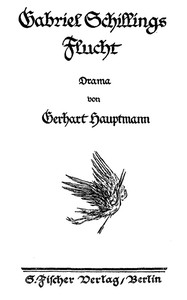
Gabriel Schillings Flucht: Drama by Gerhart Hauptmann

(3 User reviews)   4403
By Ava Marino Posted on Nov 15, 2025
In Category - Historical Travel
Hauptmann, Gerhart, 1862-1946 Hauptmann, Gerhart, 1862-1946
German
Hey, have you read Hauptmann's 'Gabriel Schilling's Flight'? It's this intense, almost claustrophobic drama from 1912. Forget epic battles—the real war here is inside a man's head. It follows a painter, Gabriel Schilling, who runs away to an Italian island with his lover to escape his wife and his old life. But guess what? You can't outrun your own conscience. The island paradise becomes a prison of his own making as his past and his guilt catch up with him. It’s a raw, psychological look at what happens when a 'fresh start' is built on a lie. Seriously gripping stuff.
Share

Read "Gabriel Schillings Flucht: Drama by Gerhart Hauptmann" Online

This book is available in the public domain. Start reading the digital edition below.

START READING FULL BOOK
Instant Access    Mobile Friendly

Book Preview

A short preview of the book’s content is shown below to give you an idea of its style and themes.

nachtwandlerischem Ausdruck dem Himmel sich darzubieten scheint. Ihr langes schwarzes Haar fließt offen über die Schulter. -- Am Strande, im Trockenen, steht ein Fischerboot. Links vorn auf der Düne, dem Schuppen gegenüber, ein Signalmast mit Strickleitern usw. Ein junges Mädchen, weiß und sommerlich gekleidet, liegt mit einem Buch zwischen Schuppen und Signalmast auf der niedrigen Düne: Lucie Heil. Von rechts vorn kommt der etwa 45jährige Tischlermeister Kühn, gefolgt von einem Lehrling. Sie tragen blaue Schürzen, keiner von beiden eine Mütze. Der Meister grüßt Lucie, der Lehrling grinst sie an. An der Rückwand des Rettungsschuppens liegt ein Stapel fichtener Bretter. Zwei davon lädt Kühn dem Lehrling auf, und dieser trägt sie davon. Kühn: Na, sind Sie auch wieder da, Freilein? Lucie: Das gehört sich doch, Meister! Kühn: Sie kommen immer, wenn die Zugvögel abreisen! Wenn die vielen Zugvögel bei uns Station machen, kommen Sie auch. Lucie: Das stimmt. Kühn: Wir warten immer drauf, daß der Herr Professor Ottfried Mäurer sich am Ende doch noch anbaut auf der Insel. Lucie: Im vorigen Herbst war es nahe daran; aber der Windmüller ging mit seinem Preis plötzlich zu hoch hinauf. Kühn: Die Leute sind dumm! Sie wissen nicht, was sie von der Hand weisen. Wenn so'n Mann, wie Professor Mäurer, sich hier auf der Insel ein Tuskulum hinsetzt, das würde doch für jeden hier von größtem Vorteil sein. Lucie: Es wäre gar nicht gut, wenn die Insel bekannt würde; denn käme erst mal das ganze Großstadtgewimmel darüber hereingebrochen, dann wär's mit ihrer Schönheit wohl aus. Kühn: Ist der Herr Professor Ihr Onkel, Freilein? Lucie (lacht): Nein, ich bin seine Großmutter, Meister Kühn. Ottfried Mäurer erscheint vom Strande her über die Dünen. Er ist ein mittelgroßer, etwa 36jähriger blonder Mann mit rötlich blondem Spitzbart. Sein Kopfhaar ist kugelrund geschoren; die Stirne breit. Ein Ausdruck schmunzelnder Schalkhaftigkeit belebt zuweilen den scharfblickenden Ernst seines Gesichts hinter der goldnen Brille und dem Kneifer. Er ist unauffällig gekleidet, hat einen Mantel um, einen weichen Filzhut auf dem Kopf, einen gewöhnlichen Stock an den Arm gehakt, und ein Buch, Quart, mit weißem Schweinslederdeckel in der Hand. Mäurer: Guten Tag, Meister Kühn. Kühn: Schön'n Dank, Herr Professor! -- Glücklich wieder auf Fischmeisters Oye angelangt? Mäurer: Gott sei Dank, Meister. -- Aber ich hatte es diesmal verdammt nötig. Kühn: Na, ja, wir haben's ja in der Zeitung gelesen. Mäurer (schmunzelnd): Was haben Sie denn in der Zeitung gelesen? Kühn: Von die schöne Bildsäule, die in Bremen errichtet worden ist. Mäurer: Die hat mir verflucht Arbeit gemacht, können Sie mir glauben, die schöne Bildsäule. Ich bin froh, daß sie mir aus dem Gehege ist. Kühn: Nu gehn Sie aber doch gleich schon wieder nach Griechenland? Mäurer: Hat das etwa auch schon wieder in der Zeitung gestanden? Kühn: Jawohl! Es gibt ja wohl Marmorbrüche dort, und da wollen Sie ja wohl Steine für neue Standbilder aussuchen. Mäurer: Na, Gott sei Dank bin ich mal erst vorläufig hier! -- Ich habe schon manchmal ganz gemütlich in Berlin in einer Weinkneipe gesessen und in der Zeitung gelesen, ich befände mich augenblicklich in Konstantinopel und modellierte die Tochter des Sultans. -- Übrigens, wem gehört denn die Gallionfigur? Kühn: Die hat der große Nordweststurm vor zwei Jahren an Land gebracht. Mäurer: Sie gefällt mir; ich würde sie gerne kaufen. Kühn: »Ilsebilse, niemand will se, kam der Koch und nahm se doch.« -- Schuckert, glaub' ich, hat sie gefunden. Mäurer: Ist das der junge Schuckert? Kühn: Jawohl. Bei Schuckerten finden Se immer so was. Der Alte hat mal einen dicken goldnen Armring aus'm Wasser rausgebracht. Soll ich vielleicht mal mit ihm reden? Mäurer: Ja, bitte, Meister; tun Sie das!...

This is a limited preview. Download the book to read the full content.

Gerhart Hauptmann, a Nobel winner, is known for gritty realism, and this play is no exception. Written in 1912, it feels surprisingly modern in its focus on a personal crisis.

The Story

Gabriel Schilling is a successful painter who has hit a wall. To escape his stifling marriage and creative block, he flees to Capri with his lover, Hanna Elias. He imagines a life of freedom and artistic rebirth. But his attempt to leave his old self behind is doomed from the start. His abandoned wife, Lucie, tracks him down, forcing a painful confrontation. Trapped on the island between the two women and haunted by his own weakness, Gabriel's dream of escape spirals into a nightmare of guilt and paralysis.

Why You Should Read It

This isn't a story about good vs. evil, but about a flawed, weak man stuck in a mess of his own creation. Hauptmann doesn't judge Gabriel harshly; he just shows us the crushing weight of his indecision. The setting is brilliant—the sunny, beautiful island contrasts perfectly with the gloomy, tense drama unfolding between the characters. You keep reading because you want to see if Gabriel will find the courage to choose anything, or if he'll just let his life fall apart.

Final Verdict

Perfect for readers who love character-driven dramas and don't need a tidy, happy ending. If you're interested in early 20th-century psychology, the pressures of society, or just a masterfully written portrait of a man in crisis, this play is a hidden gem. It's a short, powerful punch of theatre that stays with you.


ℹ️ Usage Rights

This digital edition is based on a public domain text. Feel free to use it for personal or commercial purposes.

Amanda Ramirez
2 months ago

Thanks for the recommendation.

Amanda Martinez
10 months ago

I was skeptical at first, but the storytelling feels authentic and emotionally grounded. A valuable addition to my collection.

Logan Hill
1 year ago

Without a doubt, the author's voice is distinct and makes complex topics easy to digest. Absolutely essential reading.


5
5 out of 5 (3 User reviews )

Add a Review

Your Rating *
There are no comments for this eBook.
You must log in to post a comment.
Log in


Related eBooks