
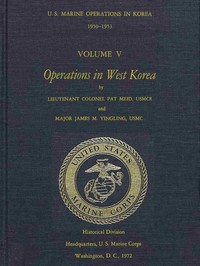
U.S. Marine Operations in Korea, 1950-1953, Volume 5 (of 5)

(5 User reviews)   4321
By Ava Marino Posted on Jan 2, 2026
In Category - Geographic History
Yingling, James M. Yingling, James M.
English
Hey, I just finished the final volume of the Marine Corps' official history of the Korean War, and it completely changed my understanding of how that conflict ended. Forget the simple 'stalemate' story. This book shows the brutal, high-stakes fighting that continued right up to the last moments before the armistice. It's not just about big battles; it's about exhausted men holding impossible hills, the political pressure to get a deal signed, and the sheer will it took to fight a 'limited war' to its bloody conclusion. If you think you know how the Korean War ended, this will make you think again. It's gripping, sobering, and packed with detail you won't find anywhere else.
Share

Read "U.S. Marine Operations in Korea, 1950-1953, Volume 5 (of 5)" Online

This book is available in the public domain. Start reading the digital edition below.

START READING FULL BOOK
Instant Access    Mobile Friendly

Book Preview

A short preview of the book’s content is shown below to give you an idea of its style and themes.

the enemy’s goal of penetrating to Seoul, the South Korean capital. Northwest of the Marine Main Line of Resistance, less than five miles distant, lay Panmunjom, site of the sporadic truce negotiations. Defense of their strategic area exposed the Marines to continuous and deadly Communist probes and limited objective attacks. These bitter and costly contests for key outposts bore such names as Bunker Hill, the Hook, the Nevadas (Carson-Reno-Vegas), and Boulder City. For the ground Marines, supported by 1st Marine Aircraft Wing squadrons, the fighting continued until the last day of the war, 27 July 1953. The Korean War marked the first real test of Free World solidarity in the face of Communist force. In repulsing this attempted Communist aggression, the United Nations, led by the United States, served notice that it would not hesitate to aid those nations whose freedom and independence were under attack. As events have subsequently proven, holding the line against Communist encroachment is a battle whose end is not yet in sight. Enemy aggression may explode brazenly upon the world scene, with an overt act of invasion, as it did in Korea in June 1950, or it may take the form of a murderous guerrilla war as it has more recently, for over a decade, in Vietnam. Whatever guise the enemy of the United States chooses or wherever he draws his battleline, he will find the Marines with their age-old answer. Today, as in the Korean era, Marine Corps readiness and professionalism are prepared to apply the cutting edge against any threat to American security. [Illustration: (signature)] L. F. CHAPMAN, JR. _General, U.S. Marine Corps,_ _Commandant of the Marine Corps_ Reviewed and approved: 12 May 1971. Preface This is the concluding volume of a five-part series dealing with operations of United States Marines in Korea between 2 August 1950 and 27 July 1953. Volume V provides a definitive account of operations of the 1st Marine Division and the 1st Marine Aircraft Wing during 1952–1953, the final phase of the Korean War. At this time the division operated under Eighth U.S. Army in Korea (EUSAK) control in the far western sector of I Corps, while Marine aviators and squadrons functioned as a component of the Fifth Air Force (FAF). The period covered by this history begins in March 1952, when the Marine division moved west to occupy positions defending the approaches to Seoul, the South Korean capital. As it had for most of the war the 1st Marine Aircraft Wing, operating under FAF, flew close support missions not only for the Marines but for as many as 19 other Allied frontline divisions. Included in the narrative is a detailed account of Marine POWs, a discussion of the new defense mission of Marine units in the immediate postwar period, and an evaluation of Marine Corps contributions to the Korean War. Marines, both ground and aviation, comprised an integral part of the United Nations Command in Korea. Since this is primarily a Marine Corps history, actions of the U.S. Army, Navy, and Air Force are presented only in sufficient detail to place Marine operations in their proper perspective. Official Marine Corps combat records form the basis for the book. This primary source material has been further supplemented by comments and interviews from key participants in the action described. More than 180 persons reviewed the draft chapters. Their technical knowledge and advice have been invaluable. Although the full details of these comments could not be used in the text, this material has been placed in Marine Corps archives for possible use by future historians. The manuscript of this volume...

This is a limited preview. Download the book to read the full content.

This isn't your typical war history. Volume 5 picks up in 1953, a time many think of as the 'quiet' end of the Korean War. James M. Yingling and the Marine Corps historians show us there was nothing quiet about it. The story follows the 1st Marine Division through a brutal final year of combat. While diplomats argued over a peace treaty at Panmunjom, Marines were fighting and dying in horrific battles for hills with names like Vegas, Reno, and Carson. The book walks you through the tense, grinding warfare of this period, where every foot of ground was contested, and the threat of a major Chinese offensive always loomed, even as everyone hoped for peace.

Why You Should Read It

You should read this because it humanizes a forgotten phase of the war. The big, sweeping offensives were over, but the danger wasn't. The book does a fantastic job showing the strain on everyone—from the privates in frozen trenches to the generals managing a fragile line. It captures the weird tension of fighting a war everyone knows is about to end, but hasn't yet. The maps and firsthand accounts put you right there. You feel the frustration, the exhaustion, and the grim determination to not lose a single man more than necessary, even as the fighting raged on.

Final Verdict

This is the essential capstone for anyone who has read the previous volumes or has a deep interest in the Korean War or Marine Corps history. It's also surprisingly accessible for general readers who want to understand how wars truly end—not with a bang, but often with a painful, protracted series of clashes. Perfect for history buffs who appreciate tactical detail and human stories, and for anyone who wants to move beyond the textbook summary of the Korean War's conclusion.


⚖️ Public Domain Notice

This publication is available for unrestricted use. Distribute this work to help spread literacy.

Brian Young
4 months ago

I started reading out of curiosity and the clarity of the writing makes this accessible. I would gladly recommend this title.

Nancy Garcia
7 months ago

Read this on my tablet, looks great.

Patricia Young
1 year ago

Finally a version with clear text and no errors.

Karen Taylor
1 year ago

I didn't expect much, but the author's voice is distinct and makes complex topics easy to digest. Definitely a 5-star read.

Ashley Clark
1 year ago

Surprisingly enough, the author's voice is distinct and makes complex topics easy to digest. Exactly what I needed.


5
5 out of 5 (5 User reviews )

Add a Review

Your Rating *
There are no comments for this eBook.
You must log in to post a comment.
Log in


Related eBooks