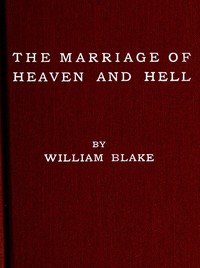
The Marriage of Heaven and Hell by William Blake

(6 User reviews)   3159
By Ava Marino Posted on Jan 2, 2026
In Category - Geographic History
Blake, William, 1757-1827 Blake, William, 1757-1827
English
Ever wonder if everything you've been taught about good and evil is wrong? William Blake's 'The Marriage of Heaven and Hell' is a wild, 1790s mind-bender that flips the script. It's not a story about people—it's a fiery argument against the rules. Blake claims that the real energy for life comes from what society calls 'evil' or 'hellish' passion, not from quiet obedience. Reading this is like having a coffee with the most brilliant, rebellious friend you've ever met, who insists that your creative chaos is actually your superpower. It's short, strange, and might just change how you see your own desires.
Share

Read "The Marriage of Heaven and Hell by William Blake" Online

This book is available in the public domain. Start reading the digital edition below.

START READING FULL BOOK
Instant Access    Mobile Friendly

Book Preview

A short preview of the book’s content is shown below to give you an idea of its style and themes.

From these contraries spring what the religious call Good and Evil. Good is the passive that obeys reason; Evil is the active springing from Energy. Good is heaven. Evil is hell. THE VOICE OF THE DEVIL All Bibles or sacred codes have been the cause of the following errors:-- 1. That man has two real existing principles, viz., a Body and a Soul. 2. That Energy, called Evil, is alone from the Body; and that Reason, called Good, is alone from the Soul. 3. That God will torment man in Eternity for following his Energies. But the following contraries to these are true:-- 1. Man has no Body distinct from his Soul. For that called Body is a portion of Soul discerned by the five senses, the chief inlets of Soul in this age. 2. Energy is the only life, and is from the Body; and Reason is the bound or outward circumference of Energy. 3. Energy is Eternal Delight. Those who restrain desire, do so because theirs is weak enough to be restrained; and the restrainer or reason usurps its place and governs the unwilling. And being restrained, it by degrees becomes passive, till it is only the shadow of desire. The history of this is written in Paradise Lost, and the Governor or Reason is called Messiah. And the original Archangel or possessor of the command of the heavenly host is called the Devil, or Satan, and his children are called Sin and Death. But in the book of Job, Milton's Messiah is called Satan. For this history has been adopted by both parties. It indeed appeared to Reason as if desire was cast out, but the Devil's account is, that the Messiah fell, and formed a heaven of what he stole from the abyss. This is shown in the Gospel, where he prays to the Father to send the Comforter or desire that Reason may have ideas to build on, the Jehovah of the Bible being no other than he who dwells in flaming fire. Know that after Christ's death he became Jehovah. But in Milton, the Father is Destiny, the Son a ratio of the five senses, and the Holy Ghost vacuum! _Note._--The reason Milton wrote in fetters when he wrote of Angels and God, and at liberty when of Devils and Hell, is because he was a true poet, and of the Devil's party without knowing it. A MEMORABLE FANCY As I was walking among the fires of Hell, delighted with the enjoyments of Genius, which to Angels look like torment and insanity, I collected some of their proverbs, thinking that as the sayings used in a nation mark its character, so the proverbs of Hell show the nature of infernal wisdom better than any description of buildings or garments. When I came home, on the abyss of the five senses, where a flat-sided steep frowns over the present world, I saw a mighty Devil folded in black clouds hovering on the sides of the rock; with corroding fires he wrote the following sentence now perceived by the minds of men, and read by them on earth:-- "How do you know but every bird that cuts the airy way Is an immense world of delight, closed by your senses five?" PROVERBS OF HELL In seed-time learn, in harvest teach, in winter enjoy. Drive your cart and your plough over the bones of the dead. The road of excess leads to the palace of wisdom. Prudence is a rich ugly old maid courted by Incapacity. He who desires, but acts not, breeds pestilence. The cut worm...

This is a limited preview. Download the book to read the full content.

Okay, let's be clear: this isn't a novel. There's no main character named John. Instead, think of it as Blake's personal manifesto, a scrapbook of explosive ideas. He takes us on a tour of a prophetic 'Hell,' where he talks with angels, rewrites proverbs, and argues that the true path to a full life isn't through following strict heavenly rules, but by embracing the raw, creative energy—the 'hellish' part of us that wants to create, desire, and break boundaries.

Why You Should Read It

I picked this up on a whim and felt like my brain got a software update. Blake was shouting about the dangers of playing it safe centuries before self-help books existed. His famous line, 'The road of excess leads to the palace of wisdom,' isn't about being reckless—it's about not being afraid of your own intensity. He makes you question why we label some emotions 'good' and others 'bad.' It's incredibly freeing. The writing itself is poetic and punchy, full of moments that make you stop and think.

Final Verdict

This is perfect for anyone feeling boxed in by 'shoulds'—the artist who's stuck, the free thinker, or just someone curious about philosophy that doesn't come from a textbook. It's not an easy beach read, but it's a short, powerful jolt. If you've ever felt that your best ideas come from a place others might disapprove of, Blake is your 18th-century cheerleader. Give it an hour. It might just argue you into feeling more alive.


ℹ️ Open Access

There are no legal restrictions on this material. You are welcome to share this with anyone.

Dorothy Wright
1 year ago

Honestly, it provides a comprehensive overview perfect for everyone. A true masterpiece.

Andrew King
6 months ago

A bit long but worth it.

Mason Martinez
1 year ago

Text is crisp, making it easy to focus.

Jennifer Wilson
10 months ago

Beautifully written.

Joseph Allen
1 year ago

Citation worthy content.

5
5 out of 5 (6 User reviews )

Add a Review

Your Rating *
There are no comments for this eBook.
You must log in to post a comment.
Log in


Related eBooks