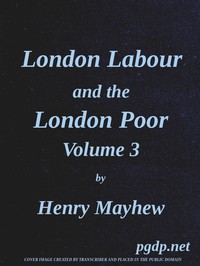
London Labour and the London Poor, Vol. 3 by Henry Mayhew

(8 User reviews)   6039
By Ava Marino Posted on Dec 26, 2025
In Category - Geographic History
Mayhew, Henry, 1812-1887 Mayhew, Henry, 1812-1887
English
Hey, have you ever wondered what life was really like for regular people in Victorian London? Not the fancy balls and carriages, but the street sellers, beggars, and people just trying to survive? I just finished a book that feels like a time machine. It's not a novel—it's a collection of interviews and observations from the 1850s. The author, Henry Mayhew, basically walked around London and talked to everyone. You hear directly from a costermonger selling vegetables, a mudlark searching the riverbank for scraps, and people living in the most desperate poverty. The main thing you feel is their raw struggle to get through each day. It completely shatters the romantic image of the era. It's heartbreaking, fascinating, and impossible to forget.
Share

Read "London Labour and the London Poor, Vol. 3 by Henry Mayhew" Online

This book is available in the public domain. Start reading the digital edition below.

START READING FULL BOOK
Instant Access    Mobile Friendly

Book Preview

A short preview of the book’s content is shown below to give you an idea of its style and themes.

lodgings, and five year in London altogether up to last September. “Before I come to London I was nothink, sir--a labouring man, an eshkewator. I come to London the same as the rest, to do anythink I could. I was at work at the eshkewations at King’s Cross Station. I work as hard as any man in London, I think. “When the station was finished, I, having a large family, thought I’d do the best I could, so I went to be foreman at the Caledonian Sawmills. I stopped there a twelvemonth; but one day I went for a load and a-half of lime, and where you fetches a load and a-half of lime they always gives you fourpence. So as I was having a pint of beer out of it, my master come by and saw me drinking, and give me the sack. Then he wanted me to ax his pardon, and I might stop; but I told him I wouldn’t beg no one’s pardon for drinking a pint of beer as was give me. So I left there. “Ever since the Great Western was begun, my family has been distributed all over the country, wherever there was a railway making. My brothers were contractors for Peto, and I generally worked for my brothers; but they’ve gone to America, and taken a contract for a railway at St. John’s, New Brunswick, British North America. I can do anything in the eshkewating way--I don’t care what it is. “After I left the Caledonian Sawmills I went to Billingsgate, and bought anythink I could see a chance of gettin’ a shilling out on, or to’ards keeping my family. “All my lifetime I’ve been a-dealing a little in rats; but it was not till I come to London that I turned my mind fully to that sort of thing. My father always had a great notion of the same. We all like the sport. When any on us was in the country, and the farmers wanted us to, we’d do it. If anybody heerd tell of my being an activish chap like, in that sort of way, they’d get me to come for a day or so. “If anybody has a place that’s eaten up with rats, I goes and gets some ferruts, and takes a dog, if I’ve got one, and manages to kill ’em. Sometimes I keep my own ferruts, but mostly I borrows them. This young man that’s with me, he’ll sometimes have an order to go fifty or sixty mile into the country, and then he buys his ferruts, or gets them the best way he can. They charges a good sum for the loan of ’em--sometimes as much as you get for the job. “You can buy ferruts at Leadenhall-market for 5_s._ or 7_s._--it all depends; you can’t get them all at one price, some of ’em is real cowards to what others is; some won’t even kill a rat. The way we tries ’em is, we puts ’em down anywhere, in a room maybe, with a rat, and if they smell about and won’t go up to it, why they won’t do; ’cause you see, sometimes the ferrut has to go up a hole, and at the end there may be a dozen or sixteen rats, and if he hasn’t got the heart to tackle one on ’em, why he ain’t worth a farden. “I have kept ferruts for four or five months at a time, but they’re nasty stinking things. I’ve had them get loose; but, bless you, they do no harm, they’re as hinnocent...

This is a limited preview. Download the book to read the full content.

Forget everything you've seen in period dramas. London Labour and the London Poor isn't a story with a plot—it's a raw, unfiltered documentary made with pen and paper. Henry Mayhew, a journalist, spent years in the 1840s and 50s walking the streets of London, notebook in hand. He didn't just observe; he stopped and talked. He asked questions and, most importantly, he listened.

The Story

This book is a collection of those conversations. Volume 3 focuses on the city's street sellers and street entertainers. You'll meet the 'pure-finders' (people who collected dog waste for the leather industry), the people who sold sand or broken pottery, and ballad singers. Mayhew records their exact words: how much they earn in a day (often just a few pennies), where they sleep, what they eat, and the constant, grinding fear of hunger and homelessness. There's no single narrative, just a mosaic of human endurance.

Why You Should Read It

Reading this feels profoundly intimate. These aren't characters; they were real people. Their voices jump off the page—sometimes defiant, often weary, always specific. You get a sense of a whole invisible economy operating on the margins. It makes you rethink what 'work' and 'poverty' really meant. It’s not dry history; it's urgent and human. I kept putting the book down just to absorb what I'd read.

Final Verdict

This is for anyone curious about real social history, the roots of modern cities, or incredible firsthand accounts. If you love deep-dive nonfiction like Behind the Beautiful Forevers or the immersive feel of a great podcast series, you'll be gripped. Be warned: it's not a light read. It's a challenging, essential look at the people history often forgets to mention.


🟢 Copyright Status

This book is widely considered to be in the public domain. Feel free to use it for personal or commercial purposes.

Melissa Hill
1 year ago

Citation worthy content.

Emily Perez
1 week ago

Wow.

Robert Wright
11 months ago

Very helpful, thanks.

4.5
4.5 out of 5 (8 User reviews )

Add a Review

Your Rating *
There are no comments for this eBook.
You must log in to post a comment.
Log in


Related eBooks