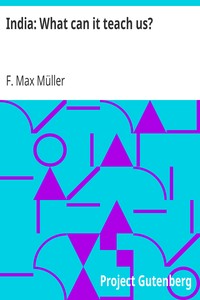
India: What can it teach us? by F. Max Müller

(5 User reviews)   3364
By Ava Marino Posted on Jan 2, 2026
In Category - Geographic History
Müller, F. Max (Friedrich Max), 1823-1900 Müller, F. Max (Friedrich Max), 1823-1900
English
Ever wonder how a 19th-century German scholar became one of India's biggest champions in the West? That's the fascinating story behind Max Müller's 'India: What can it teach us?'. Written over a century ago, this book isn't just a dusty academic lecture. It's a passionate argument from a man who saw ancient Indian wisdom as a vital missing piece for the modern world. Müller faced huge skepticism from his European peers who often dismissed Eastern thought. His mission? To prove that Sanskrit texts and Vedic philosophy held profound lessons about life, spirituality, and the human mind that the West desperately needed. It's a surprisingly personal look at cultural connection, and it asks a question that still matters today: what can we learn when we truly listen to voices from a different tradition?
Share

Read "India: What can it teach us? by F. Max Müller" Online

This book is available in the public domain. Start reading the digital edition below.

START READING FULL BOOK
Instant Access    Mobile Friendly

Book Preview

A short preview of the book’s content is shown below to give you an idea of its style and themes.

scholar, not intending either to attack or defend Christian theology. His style is charming, because he always writes with freedom and animation. In some passages possibly his language might be misunderstood. We have thought it best to add a few notes. The notes of the American editor are signed "A.W.;" ours, "Am. Pubs." * * * * * DEDICATED TO E. B. COWELL M.A., LL.D., PROFESSOR OF SANSKRIT AND FELLOW OF CORPUS CHRISTI COLLEGE IN THE UNIVERSITY OF CAMBRIDGE. * * * * * MY DEAR COWELL: As these Lectures would never have been written or delivered but for your hearty encouragement, I hope you will now allow me to dedicate them to you, not only as a token of my sincere admiration of your great achievements as an Oriental scholar, but also as a memorial of our friendship, now more than thirty years old, a friendship which has grown from year to year, has weathered many a storm, and will last, I trust, for what to both of us may remain of our short passage from shore to shore. I must add, however, that in dedicating these Lectures to you, I do not wish to throw upon you any responsibility for the views which I have put forward in them. I know that you do not agree with some of my views on the ancient religion and literature of India, and I am well aware that with regard to the recent date which I have assigned to the whole of what is commonly called the Classical Sanskrit Literature, I stand almost alone. No, if friendship can claim any voice in the courts of science and literature, let me assure you that I shall consider your outspoken criticism of my Lectures as the very best proof of your true and honest friendship. I have through life considered it the greatest honor if real scholars, I mean men not only of learning, but of judgment and character, have considered my writings worthy of a severe and searching criticism; and I have cared far more for the production of one single new fact, though it spoke against me, than for any amount of empty praise or empty abuse. Sincere devotion to his studies and an unswerving love of truth ought to furnish the true scholar with an armor impermeable to flattery or abuse, and with a visor that shuts out no ray of light, from whatever quarter it may come. More light, more truth, more facts, more combination of facts, these are his quest. And if in that quest he fails, as many have failed before him, he knows that in the search for truth failures are sometimes the condition of victory, and the true conquerors often those whom the world calls the vanquished. You know better than anybody else the present state of Sanskrit scholarship. You know that at present and for some time to come Sanskrit scholarship means discovery and conquest. Every one of your own works marks a real advance, and a permanent occupation of new ground. But you know also how small a strip has as yet been explored of the vast continent of Sanskrit literature, and how much still remains _terra incognita_. No doubt this exploring work is troublesome, and often disappointing, but young students must learn the truth of a remark lately made by a distinguished member of the Indian Civil Service, whose death we all deplore, Dr. Burnell, "that no trouble is thrown away which saves trouble to others." We want men who will work hard, even at the risk of seeing their labors unrequited;...

This is a limited preview. Download the book to read the full content.

Let's set the scene: it's the late 1800s, and Europe is at the height of its colonial power. The general attitude toward India is often one of superiority. Enter Friedrich Max Müller, a German-born Oxford professor who has spent his life studying Sanskrit and ancient Indian texts. This book is actually a series of lectures he gave, and his goal is direct and bold. He wants to convince his audience—and the wider Western world—that they have it all wrong. India isn't a 'backward' civilization to be looked down upon, but a rich, ancient culture with profound philosophical and spiritual insights that the material-focused West has lost sight of.

Why You Should Read It

What grabbed me was Müller's genuine awe. This isn't a dry comparison of religions. You can feel his excitement as he explains concepts from the Vedas and Upanishads, connecting Indian ideas about the soul, duty, and the universe to questions we all ask. He makes a compelling case that understanding Indian thought isn't just academic—it's a way to better understand ourselves. Reading him defend the depth of Indian philosophy against the prejudices of his time is both historical and weirdly current. It’s a reminder that real learning requires humility.

Final Verdict

Perfect for curious minds interested in the roots of East-West dialogue, or anyone who enjoys seeing history through the eyes of a passionate outsider. It's not a light read, but it's a rewarding one. You'll come away with a fresh perspective on both 19th-century Europe and the timeless wisdom of ancient India, all thanks to a scholar who dared to ask, 'What can we learn?'


📚 Legal Disclaimer

This historical work is free of copyright protections. It is now common property for all to enjoy.

Donald Perez
1 year ago

Based on the summary, I decided to read it and the content flows smoothly from one chapter to the next. One of the best books I've read this year.

George Jackson
1 year ago

Having read this twice, the narrative structure is incredibly compelling. I learned so much from this.

Robert King
4 months ago

Without a doubt, the arguments are well-supported by credible references. This story will stay with me.

Michael Wilson
1 year ago

Without a doubt, the storytelling feels authentic and emotionally grounded. Exceeded all my expectations.

Robert Rodriguez
1 year ago

Surprisingly enough, the depth of research presented here is truly commendable. I couldn't put it down.

4
4 out of 5 (5 User reviews )

Add a Review

Your Rating *
There are no comments for this eBook.
You must log in to post a comment.
Log in


Related eBooks